A guide for anyone who's ever stared at a half-empty guest list and sighed
Let's start with a feeling you know.
You're running an event. A tournament, a study group, a coffee meetup, a coaching call. You've picked a date. You've written a nice description. And now comes the part that nobody enjoys: chasing people.
You message a few friends. Some say yes, some say "maybe next time", most say nothing at all. You wait. You check again. You feel weird sending a second message. You feel weirder sending a third. The event is tomorrow and you still have eight empty seats and you're tired.
We built Auto-Invite so you never have to do that again.
And the best way to explain how it works is to pretend you're five.
Imagine you're planning a birthday party
You want 20 friends to come to your party. But you don't know which 20 will actually show up. Some are busy. Some never reply to anything. Some would love to come but nobody asked them.
So what would a really, really thoughtful friend do for you?
They wouldn't spam all 200 people in your contact list at once — that's embarrassing.
They wouldn't message one person per day for a month — you'd never get to 20.
A thoughtful friend would do this:
"Let me text ten people first and see who says yes. If loads of them say yes, I'll chill — we're almost there. If nobody replies, I'll try a few more. If someone hasn't answered by tomorrow, I'll gently nudge them. If they still don't answer the day after, I'll try reaching them a different way — maybe email instead of a DM. And once you hit 20 yeses, I'll stop immediately so you don't end up with 40 people in a tiny room."
That's the whole system. Everything below is just the thoughtful friend, doing their job, every few minutes, for as long as you need.
Meet your thoughtful friend
Here's what they actually do from the moment you flick the switch:
🎯 First, they ask you three tiny things
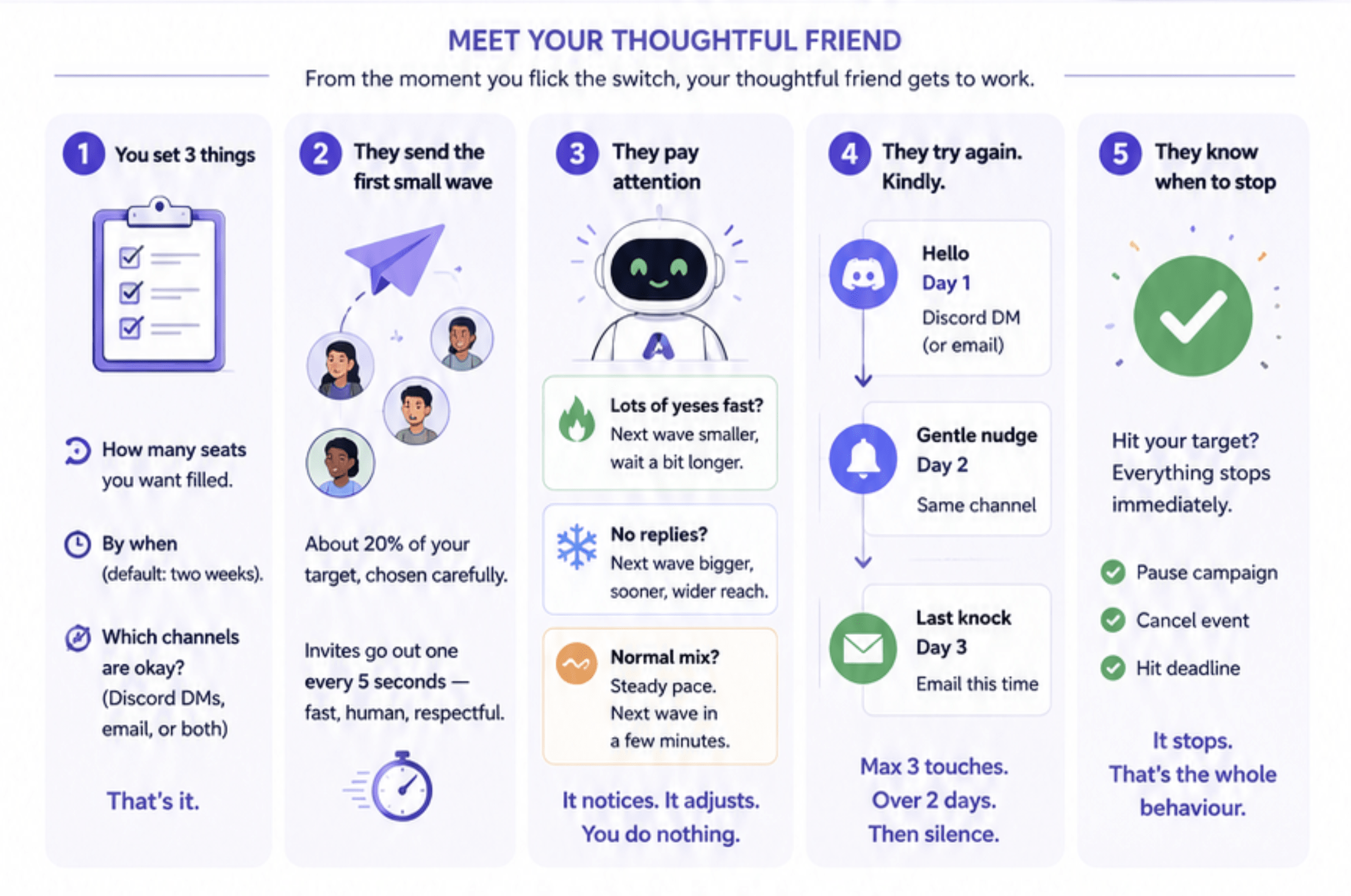
- How many seats do you want filled? (20? 50? 200?)
- By when? (default: two weeks, you can change it)
- Which channels are okay? (Discord DMs, email, or both)
That's it. No forms. No 15-step wizard. No "advanced settings" tab to panic about.
📬 Then they send the first small wave
Not a blast. A small, careful first wave — about 20% of your target. Ten people if you want fifty, a hundred if you want five hundred.
Why only 20%? Because your thoughtful friend doesn't actually know yet which of your community members are going to be excited about this event. So they test the water with a small group chosen carefully — people who've come to your past events, people whose schedules match, people who show up when certain other people also show up (this matters more than you'd think — people come to events because their friends are coming).
The first wave goes out one invite every five seconds — slow enough to feel human, fast enough that ten invites finish in less than a minute.
🧠 Then they pay attention
This is the part people always light up about when we show them.
After the first wave finishes, your thoughtful friend looks at what happened.
Lots of people said yes quickly? 🔥 That means this event is going to fill up fast. So the next wave gets smaller, and it waits a bit longer. No reason to rush — your event is already on its way to full.
Nobody replied at all? 🥶 That means the message didn't land, or those ten weren't the right ten. So the next wave gets bigger, goes out sooner, and reaches further into your community.
A normal mix? Steady as she goes. Another wave in a couple of minutes.
You don't have to tell the system any of this. It just... notices. And adjusts. And the effect is that your events fill up at a pace that matches how exciting they are, without you ever touching a dial.

📞 And if someone doesn't respond, they try again. Kindly.
Here is the part that most invite tools get wrong. They either give up after one message, or they pester people until everyone hates them.
Your thoughtful friend does exactly three touches, spaced out over two days:
- The first hello. Sent via Discord DM if we can, email if we can't.
- The gentle nudge. 24 hours later, if they haven't replied. Same channels.
- The last knock. 48 hours later, on email this time — because if someone ignored two Discord pings, they're probably not on Discord this week. Email is the polite "last chance" channel.
After that, the system stops. Forever. We never hassle the same person about the same event a fourth time. Not because we're being lazy — because it's the right thing to do, and because your community trusts invitations from you exactly as much as you don't abuse them.
🛑 And they know when to stop
The moment your event hits its target number of seats, everything pauses mid-stride. No more waves. No more nudges. The invite engine just quietly turns itself off and marks your event as "done". You don't have to remember to cancel anything.
Same thing happens if you:
- Pause the campaign (planning something? Just pause it.)
- Cancel the event
- Hit the deadline you set
It stops. That's the whole behaviour. It's boring and reliable on purpose.
Let's follow one real guest
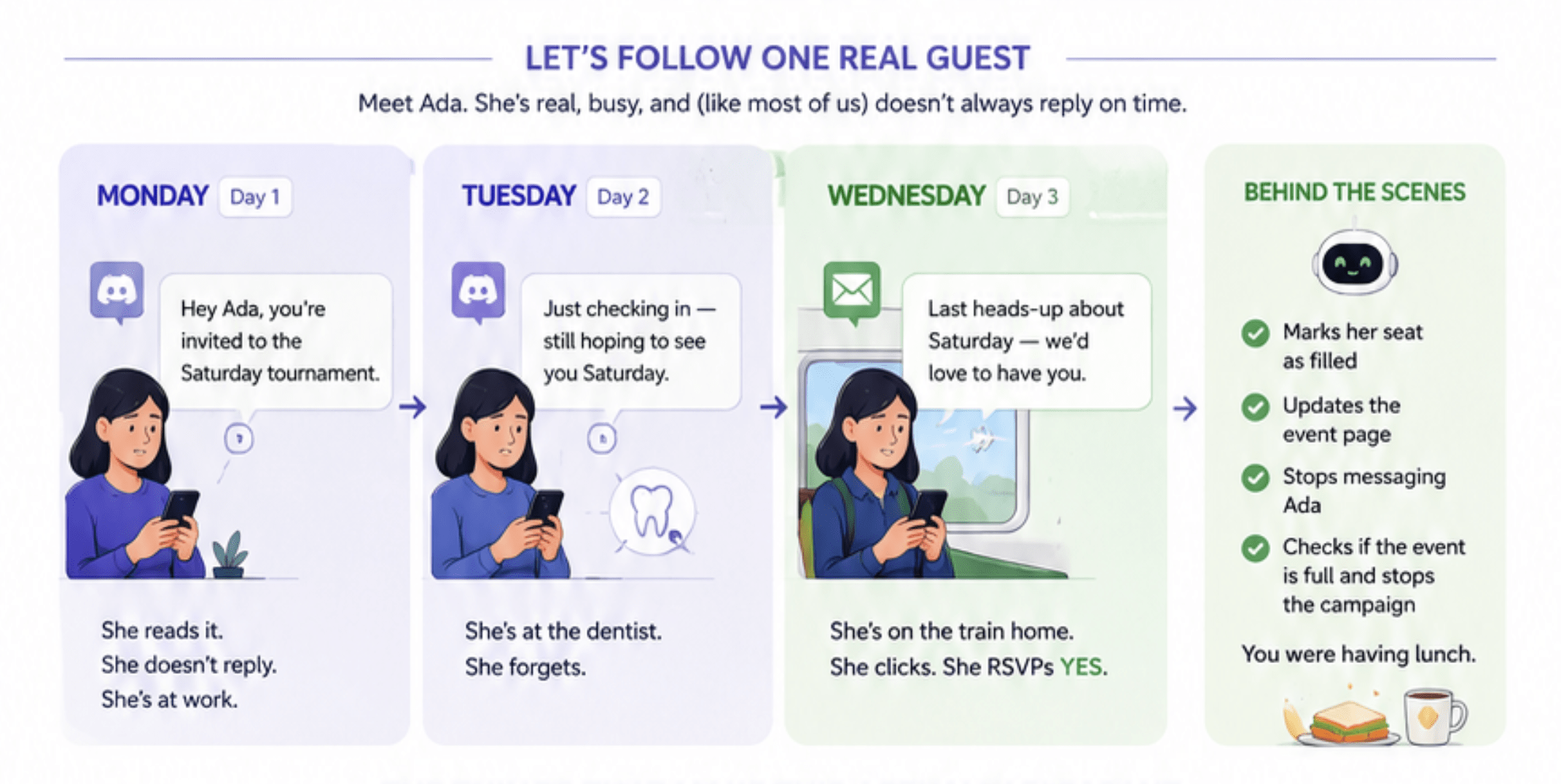
Meet Ada. She's a member of your community. She's been to a couple of your events before but missed the last three.
Monday afternoon — you flip Auto-Invite on. You want 20 guests.
A minute later — Ada's phone buzzes. A Discord DM from your event: "Hey Ada, you're invited to the Saturday tournament." She reads it. She doesn't reply. She's at work.
Tuesday afternoon — Another Discord ping. "Just checking in — still hoping to see you Saturday." She's at the dentist. She forgets.
Wednesday afternoon — An email lands in her inbox. "Last heads-up about Saturday — we'd love to have you." She's on the train home. She clicks. She RSVPs yes.
The system immediately:
- Marks her seat as filled
- Tells your event page she's coming
- Stops sending her anything else
- Checks whether your event is now full and, if it is, stops the whole campaign
Ada doesn't know any of this happened in the background. From her side, she just got a friendly message, ignored it twice because life, and clicked it on the third try. That third try was an email, and it landed because she doesn't check Discord on weekdays. If we hadn't tried email, we'd have lost her.
You didn't do any of it. You were having lunch.
The things that make this actually pleasant
A few details that seem small but make a huge difference when you live with this system day to day:
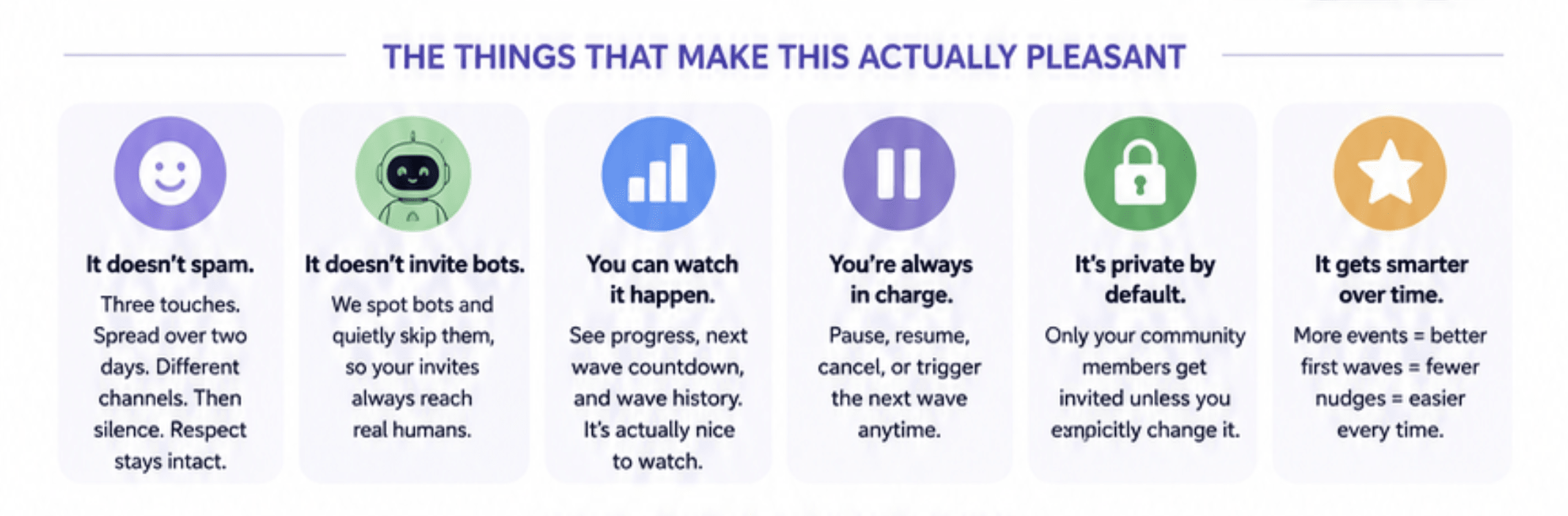
🙂 It doesn't spam. Three touches. Spread over two days. Different channels. Then silence. Your community's relationship with you stays intact.
🤖 It doesn't invite bots. Discord communities collect bots like lint on a sweater. Our system recognises them and quietly skips them, so your invite counts are always real humans.
📊 You can watch it happen. Your event page shows a little progress bar, a "next wave in 2 min 14 sec" countdown, and the history of every wave ("Wave 2 · 5 invites sent · 60% accepted"). It's genuinely nice to watch — a bit like watching dough rise.
⏸️ You're always in charge. Pause. Resume. Cancel. Trigger the next wave right now if you're impatient. It's your event. The system is just the helper.
🔒 It's private by default. Only members of your community get invited. No random strangers unless you explicitly turn that on. Your community is your community.
✨ It gets smarter over time. The more events you run, the more the system learns about who actually shows up when, and the better its first wave gets. Early events take a few more nudges; later events basically fill themselves.
What this really gives you
Here's the honest version.
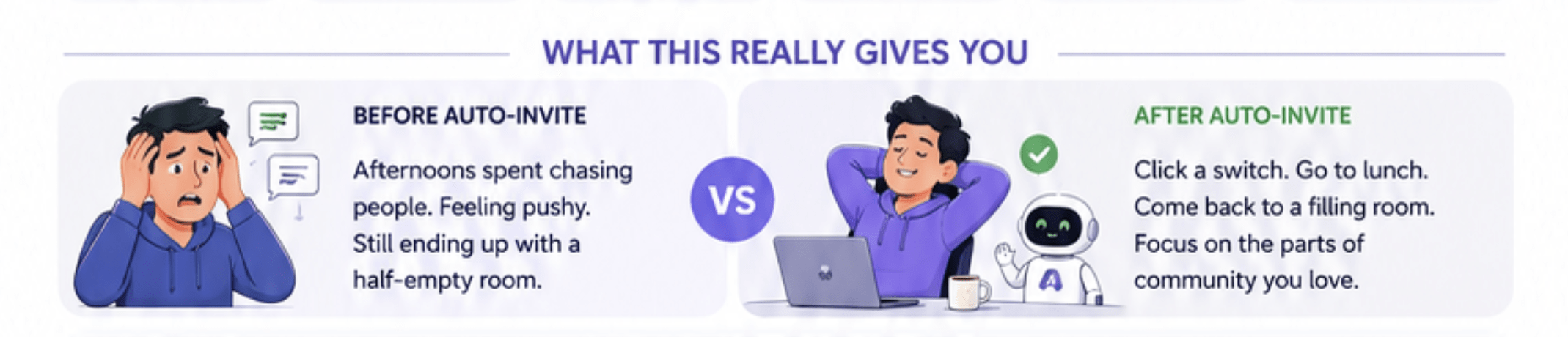
Before Auto-Invite, running a community event meant spending an afternoon messaging people, feeling bad about being pushy, and still ending up with a half-empty room.
After Auto-Invite, it means clicking a switch, going to lunch, coming back to see that the room is filling up, and then getting on with the parts of community-building you actually enjoy — the event itself, the people, the conversation.
The invite work doesn't disappear. It just stops being your work.
One-sentence version
You tell the robot how many friends you want, and the robot sends kind little messages to the right people, watches who says yes, nudges the ones who forget, and stops the moment your party is full.
That's really it.
If you run events and you've been quietly dreading the chasing part — we made this for you. Flick it on. Go to lunch. Come back to a full room.